NX
NXplace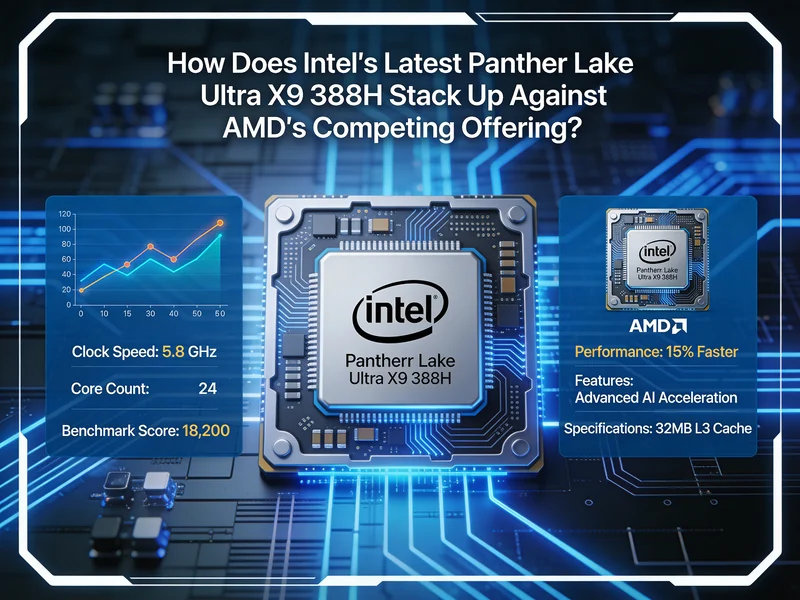
The Intel Core Ultra X9 388H from the Panther Lake series (Core Ultra 300) is a high-end mobile processor excelling in efficiency and multi-threaded tasks, with strong single-core speeds up to 5.1 GHz, a powerful integrated Arc B390 GPU, and 50 TOPS NPU for AI workloads, positioning it as a top Copilot+ PC chip. It outperforms Intel's prior Arrow Lake in efficiency and matches or beats AMD's Ryzen AI 9 HX 370 and Zen 5 rivals in many benchmarks, though it trails Apple's M4/M5 in raw single-core power.[1][2][3][4][5]
Panther Lake's X9 388H uses Intel's 18A process for better power efficiency in thin laptops. Here's the core config:
Interesting fact: Despite only 4 P-cores, it punches above its weight—its Cinebench 2024 single-core score of 131 beats a desktop Ryzen 5 9600X (130) and i7-14700K (129), thanks to the compute tile design.[3]
Benchmarks from reviews show the X9 388H thriving at low power (e.g., 11-15W for top single-core), making it ultra-efficient for laptops.
Single-Core: Tops mobile x86 charts at ~3,036 Geekbench 6, edging Arrow Lake, Snapdragon X1E-84-100, and AMD Ryzen AI 9 465 (8% slower); Lunar Lake and ARM chips like Apple M5 lead slightly.[2][3]
Multi-Core: Crushes Lunar Lake (nearly 2x faster) and matches high-power Zen 5/Arrow Lake at 64/46W limits; up to 24% better than Arrow Lake at similar power. Examples:
| Benchmark | Core Ultra X9 388H | AMD Ryzen AI 9 HX 370 | Notes |
|---|---|---|---|
| Multi-thread (Intel claim) | Up to 24% faster | Baseline | At similar power[5] |
| Geekbench 6 Multi | ~930 (est. from trends) | 1022-1107 | AMD edges in some[2] |
| 7-Zip MT | 112,695 MIPS | N/A (Ryzen 7 8845HS: 84k) | Intel wins[3] |
Graphics/Gaming: Arc B390 delivers "surprisingly high" frames in demanding titles, beating prior Intel iGPUs handily.[6]
AMD's Ryzen AI 9 HX 370 (Strix Point, Zen 5) and Ryzen AI 9 465 are direct rivals—more P-cores (12 total) but higher power draw. Intel often wins on efficiency:
| Aspect | Intel X9 388H Wins | AMD Wins | Tie/Source |
|---|---|---|---|
| Single-Core | Faster than Ryzen AI 9 465 (8% edge); lower power (11-15W vs. higher)[2] | N/A | [2][3] |
| Multi-Core | 24% ahead of HX 370 at same power; beats in 7-Zip[3][5] | HX 370 higher peaks (e.g., Geekbench ~1100)[2] | Power-limited tests favor Intel[2][5] |
| Efficiency | Outpaces Zen 5; closer to Lunar Lake/ARM[2] | Strong raw multi with more cores | Intel at lower TDP[2] |
| Graphics | Arc B390 > Radeon 890M in some games (XeSS helps)[6] | Radeon often leads raster | Game-dependent[6] |
| AI | 50 TOPS NPU (similar to AMD's 50)[4] | Comparable | [4] |
Key Insight: Intel prioritizes low-power prowess for all-day laptops, beating AMD in balanced scenarios but yielding peak multi-core to AMD's higher TDP chips. Critics note 4 P-cores limit future-proofing for gaming/heavy apps—AMD's 12 cores offer more headroom.[3]
Panther Lake laptops (e.g., with X9 388H) are rolling out now, focusing on AI PCs with stunning battery life and slim designs.[1] For general users, it's a versatile beast; power users might compare real-world laptop reviews.