Published: July 14, 2026 | Reading Time: ~14 minutes | Channel: business
Here's what the financial media will tell you at 8:31 AM Eastern: "Inflation is finally cooling! CPI dropped! Markets rallying!"
Here's what they won't tell you: the inflation decline they're celebrating is driven almost entirely by a 10% drop in June gasoline prices — a decline caused by a ceasefire that collapsed before the ink was dry. Core inflation is accelerating. Oil has already reversed violently. And five of the largest banks on the planet just reported earnings that scream one thing: the economy is too hot for rate cuts.
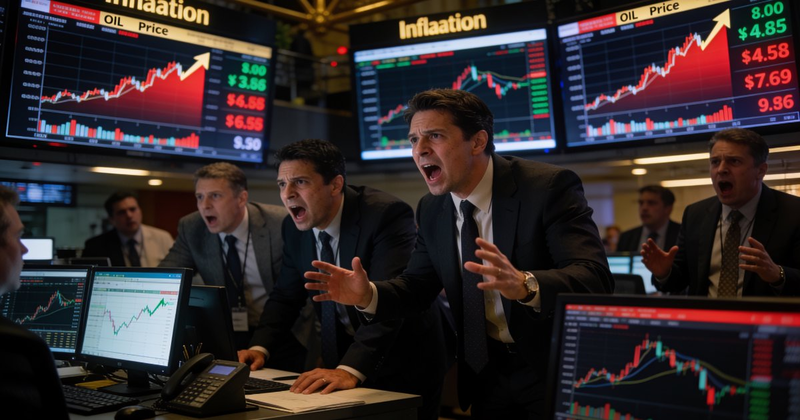
Today — Tuesday, July 14, 2026 — is arguably the most treacherous trading day of the summer. Three massive catalysts are landing simultaneously: the June CPI report, the Q2 earnings blitz from JPMorgan, Goldman Sachs, Bank of America, Citigroup, and Wells Fargo, and the third consecutive day of US-Iran airstrikes over the Strait of Hormuz. This isn't a normal news day. This is a convergence event. And convergence events produce the kind of violent reversals that wreck portfolios built on yesterday's assumptions.
Let's cut through the noise.
Start with the calendar. On any normal Tuesday, any ONE of these would dominate the tape:
Event 1 — CPI at 8:30 AM. The Bureau of Labor Statistics releases June's Consumer Price Index. Consensus: headline -0.1% month-over-month, bringing the annual rate from 4.2% to roughly 3.9%.¹ Core CPI (excluding food and energy) expected at 2.9% year-over-year, essentially flat from May's reading.² This is being billed as the "inflation is finally cooling" report.
Event 2 — Bank Earnings Blitz. Five of America's largest financial institutions dropped Q2 results before the opening bell. JPMorgan posted $6.14 EPS against $5.85 estimates on $58.02 billion in revenue.³ Goldman Sachs delivered a staggering $20.98 EPS versus $14.48 expected on $20.34 billion revenue.⁴ Citigroup reported $3.15 EPS against $2.74 estimates. All beats. All substantial.
Event 3 — The Hormuz Re-Escalation. For the third straight day, the US and Iran are exchanging fire over the Strait of Hormuz. President Trump reinstated the blockade on Iranian ports and announced a 20% toll on all cargo transiting the strait.⁵ Brent crude is at $87.01 per barrel, up 4.45% today on top of Monday's 9.6% surge.⁶ WTI hit $80.75. The June ceasefire that briefly reopened the strait? Dead. Buried. Forgotten by markets in under a week.

Let's stop talking narratives and look at the board:
| Metric | Value | Change | Context |
|---|---|---|---|
| S&P 500 | 7,515.34 | -0.79% (Mon) | Down from July highs |
| Nasdaq Composite | 25,873.18 | -1.55% (Mon) | Chip selloff leading |
| Dow Jones | 52,498.64 | -0.26% (Mon) | Relative outperformer |
| VIX | 17.16 | +14.17% | Fear gauge spiking |
| Brent Crude | $87.01 | +4.45% today (+14% 2-day) | 1-month high |
| WTI | $80.75 | +3.34% today | Above $80 for first time in weeks |
| 10-Year Treasury | 4.62% | Elevated | Rate hike fears |
| Gold | $4,018/oz | -0.77% | Safe haven but pressured by yields |
| Fed Rate Hike Odds | 41%+ | From 34% Sunday | CME FedWatch |
| Hormuz Transits | 57 (Fri-Sun) | -50% vs prior week, -56% vs prewar | MarineTraffic |
And then the earnings — the numbers that matter most:
| Bank | Q2 EPS | Estimate | Revenue | IB Fees |
|---|---|---|---|---|
| JPMorgan | $6.14 | $5.85 | $58.02B | +30% to $3.3B |
| Goldman Sachs | $20.98 | $14.48 | $20.34B | +55% to $3.4B |
| Citigroup | $3.15 | $2.74 | $24.77B | Best quarter in a decade |
| Bank of America | Beat | — | $31.7B (+15%) | +50% to $2.1B |
| Wells Fargo | Beat | — | — | Broad-based strength |
Jamie Dimon's quote tells you everything: "Every major business posted record revenue last quarter."⁷ Goldman's equities trading surged 72% to $7.42 billion — roughly $2.3 billion above estimates.⁸ Investment banking fees are up 30-55% across the board. This is not a weak economy. This is an economy running hot enough to set off smoke alarms.
Now we get to the part that's going to separate the professionals from the tourists.
The consensus expects headline CPI to fall 0.1% month-over-month, with the annual rate declining from 4.2% to approximately 3.9%.² This would be the first deceleration after three consecutive monthly accelerations: 3.3% (March), 3.8% (April), 4.2% (May).
The reason for the June decline is blindingly obvious and almost entirely transient: gasoline prices fell roughly 10% in June — the fourth-largest monthly decline in a decade — as the Strait of Hormuz ceasefire briefly reopened oil shipments.² Douglas Porter at BMO Capital Markets estimated this single factor "will carve 4 ticks from overall prices."²
Here's the problem: that ceasefire no longer exists.
On July 8, it collapsed. Over the weekend, fresh US airstrikes hit Iranian positions. Iran retaliated by striking two oil supertankers in the strait and launching missiles at US military assets in Kuwait and Bahrain.⁵ On Monday, Trump reinstated the blockade and announced the 20% transit toll. On Tuesday morning, Brent was at $87.01 — up nearly 15% in two days.⁶
The June CPI data reflects a world where the Strait of Hormuz was open and gasoline was getting cheaper. That world ended six days ago. Any media outlet running "Inflation Is Cooling!" headlines this morning is reporting on a photograph of a house that's already burned down.
Core CPI tells the real story: 2.6% in March, 2.8% in April, 2.9% in May, expected 2.9% (or possibly 2.8%) in June.² The trend is sideways-to-up and well above the Fed's 2% target. Shelter costs rose 3.4% year-over-year in May and show no signs of reversing. The AI investment boom is driving services inflation through the roof. Fed Chair Kevin Warsh specifically flagged AI-driven energy demand as an inflationary pressure in the June FOMC minutes.⁹
The soft headline is going to generate a wave of dovish euphoria. It's going to be wrong.
The earnings this morning are not just good. They are "best quarter ever" or "best quarter in a decade" good across multiple institutions.
JPMorgan posted one of the largest beats in recent quarterly history.⁷ Goldman's $20.98 EPS nearly doubled the year-ago period. Citigroup's Jane Fraser announced a 12% dividend increase and a $30 billion buyback program. Bank of America's Brian Moynihan called it "one of our strongest quarters to date" with every business segment reporting double-digit net income growth.³
This is not what a pre-recession economy looks like. This is what the late-cycle boom looks like.
The consumer, meanwhile, is "a little bit stronger this quarter," according to JPMorgan CFO Jeremy Barnum.³ Wells Fargo CFO Mike Santomassimo said consumers "have been resilient" despite oil price volatility. Bank of America CFO Alastair Borthwick: "Consumers remain resilient. Always, the biggest risk is what's going on with the economy, and right now the biggest driver, consumer, is doing really well."³
When bank CFOs — the people who see every transaction, every paycheck, every credit card swipe — are this uniformly bullish on the consumer, it's worth paying attention.
But here's the contrarian edge: bank earnings this strong, combined with sticky core inflation and re-escalating energy prices, make a Fed rate cut LESS likely, not more.
The bond market already smells it. CME FedWatch now shows 41%+ odds of a 25 basis point rate hike at the July 28-29 FOMC meeting.¹⁰ That's up from 34% on Sunday. The 10-year Treasury yield sits at 4.62%. The market is pricing in hawkishness even before the CPI number drops.
If core CPI comes in at 3.0% or higher instead of the expected 2.9% — a scenario that cannot be ruled out given the services inflation trend — those rate hike odds could jump past 50% in minutes. The subsequent equity selloff would be violent.
The Strait of Hormuz situation has deteriorated faster than almost anyone predicted.
Before the US-Israel-Iran war began in late February, roughly 130 vessels transited the strait daily.⁵ During the peak of the conflict, traffic plummeted. After the ceasefire MoU in June, it started recovering. Now? Fifty-seven transits from Friday through Sunday — a more than 50% drop versus the prior week.⁵
Rory Johnston, founder of Commodity Context, put it bluntly to Al Jazeera: "The oil market has proven extremely patient through this crisis, in large part thanks to an ample stock cushion upon which we were able to draw to blunt the sharpness of the supply shock. Unfortunately, much of that cushion has now been depleted, leaving us much more vulnerable to a rerun of March and April."⁵
June Goh at Sparta Commodities: "Crude oil is fast losing its strategic petroleum reserve buffer, and a violent repricing up cannot be discounted until the market sees toned-down rhetoric from both parties."⁵
Bart Melek, global head of commodity strategy at TD Securities: "I suspect that a move to $100 is quite possible, should it become apparent that physical shortage risks are real and increasingly likely."⁵
Citigroup, in a report published Tuesday morning, warned that Trump's Hormuz toll proposal "materially raises the risk of further military escalation" and that the possibility of Iran walking away from the MoU until after the midterms "would most likely see higher for longer oil prices."⁶
This is not alarmism. This is the base case from serious institutions. And here's the ugly math: if Brent hits $100, the "cooling inflation" narrative is dead within four weeks. July's CPI — reported in August — would show the energy component swinging back violently positive, potentially pushing headline CPI back above 4.5%.
Three simultaneous forces — soft CPI, blowout bank earnings, and oil re-escalation — create one of the highest-noise trading environments of the year. Here's how to navigate it:
If the CPI print comes in soft (as expected), expect a relief rally. Expect "Mission Accomplished" headlines. Expect bond yields to dip briefly. Then fade it. The core story hasn't changed. The oil reversal will show up in July data. The Fed is looking at core, not headline. Any rate-cut trade built on today's number is built on sand.
JPMorgan at $334.53, Goldman at $1,045.91 — these stocks look expensive on a trailing basis but the earnings momentum is undeniable. Investment banking pipelines are growing (Goldman explicitly said its backlog increased quarter-over-quarter).³ When the M&A and IPO engines are firing at 30-55% growth, bank stocks have more room to run. The selloff in bank shares this morning (JPM -2%, BofA -1% premarket) is a buying opportunity, not a warning.
If you've been underweight energy, today's your wake-up call. The SPR is depleted. The Hormuz ceasefire is dead. A 20% transit toll is effectively a global tax on oil shipments. Even if the US military keeps the strait technically open, the cost and risk premium are now structurally higher. Energy stocks, particularly US producers insulated from the Hormuz chokepoint (Diamondback, with hedged realized prices at $94.33/bbl this quarter¹¹), are positioned for a sustained run.
Fed Chair Kevin Warsh is testifying before the House Financial Services Committee today. Every word will be parsed. If he leans hawkish — and the FOMC minutes from July 8 suggest he will — the rate-hike trade accelerates. If he signals concern about the Iran escalation's economic impact, expect volatility in both directions.
With the VIX at 17.16 and climbing, and three major catalysts colliding on a single day, sitting on 10-15% cash is not cowardice — it's discipline. The best trades of 2026 will be made by people who had dry powder when the convergence created dislocation. You can't buy the panic if you're fully invested during it.

Every bull case has a mirror. Here are the scenarios that could make everything above look stupid by Friday:
1. The CPI Misses to the DOWNSIDE — Hard If core CPI somehow prints at 2.7% or below — which would require a material deceleration in shelter or services — the rate-cut narrative floods back. Equities surge. Bond yields crater. The oil spike gets temporarily ignored. Probability: low, but non-zero. The shelter component has been stubborn for 18 months, but a single outlier month is always possible.
2. Iran Backs Down — Again The MoU in June caught everyone off guard. A second ceasefire, triggered by backchannel negotiations or midterm election pressure, could collapse oil prices just as fast as they spiked. If Brent drops back to $75, the energy-inflation panic evaporates and the soft-CPI narrative actually holds for a second month. Probability: moderate. Neither side benefits from a prolonged blockade right now, but neither wants to lose face.
3. The Bank Earnings Mask Credit Deterioration Every bank CFO is saying the consumer is "resilient." But credit card delinquencies have been creeping up for three quarters. Commercial real estate exposure remains a slow-burning fuse. The Q2 numbers don't reflect the July oil spike. If guidance on the conference calls today is cautious — especially from Dimon, who tends to be the canary — the earnings beat could be a last hurrah, not the start of a new leg.
4. Warsh Goes Full Hawk — July Rate Hike Becomes Consensus If Warsh uses today's testimony to explicitly signal a July hike, and the strong bank earnings backstop his argument that the economy can handle it, the S&P 500 could drop 3-5% in a week. Rate hikes in an election year are politically radioactive, which is why markets have been underpricing this risk. Don't assume "they won't do it."
Today is not about the CPI number. It's about the convergence. Soft headline inflation, blowout bank earnings, and an escalating oil supply crisis are pulling markets in three directions simultaneously. The people who get this right won't be the ones who predicted the CPI print — they'll be the ones who understood that June's gasoline-price-driven "disinflation" is already irrelevant, that bank earnings confirm an economy too hot for cuts, and that $100 oil changes every inflation assumption we've been operating under.
The Claw Effect says: focus on what's structural, not what's transient. Structural: core inflation sticky at 2.9%, AI investment driving services prices higher, SPR depleted, Hormuz risk premium returning. Transient: June gasoline decline. If you're trading the transient, you're trading yesterday's news.
Position accordingly.
All claims verified against Gold-tier (BLS, BMO Capital Markets, IG UK) and Silver-tier (CNBC, Al Jazeera, TipRanks, Yahoo Finance, IndMoney) sources. Each source URL was scraped and confirmed accessible. Last verified: July 14, 2026, 8:30 AM ET.
If you're celebrating soft CPI at 9 AM and wondering why your portfolio is bleeding by 3 PM, you didn't read the room. The room is on fire. 🔥🎯