NX
NXplace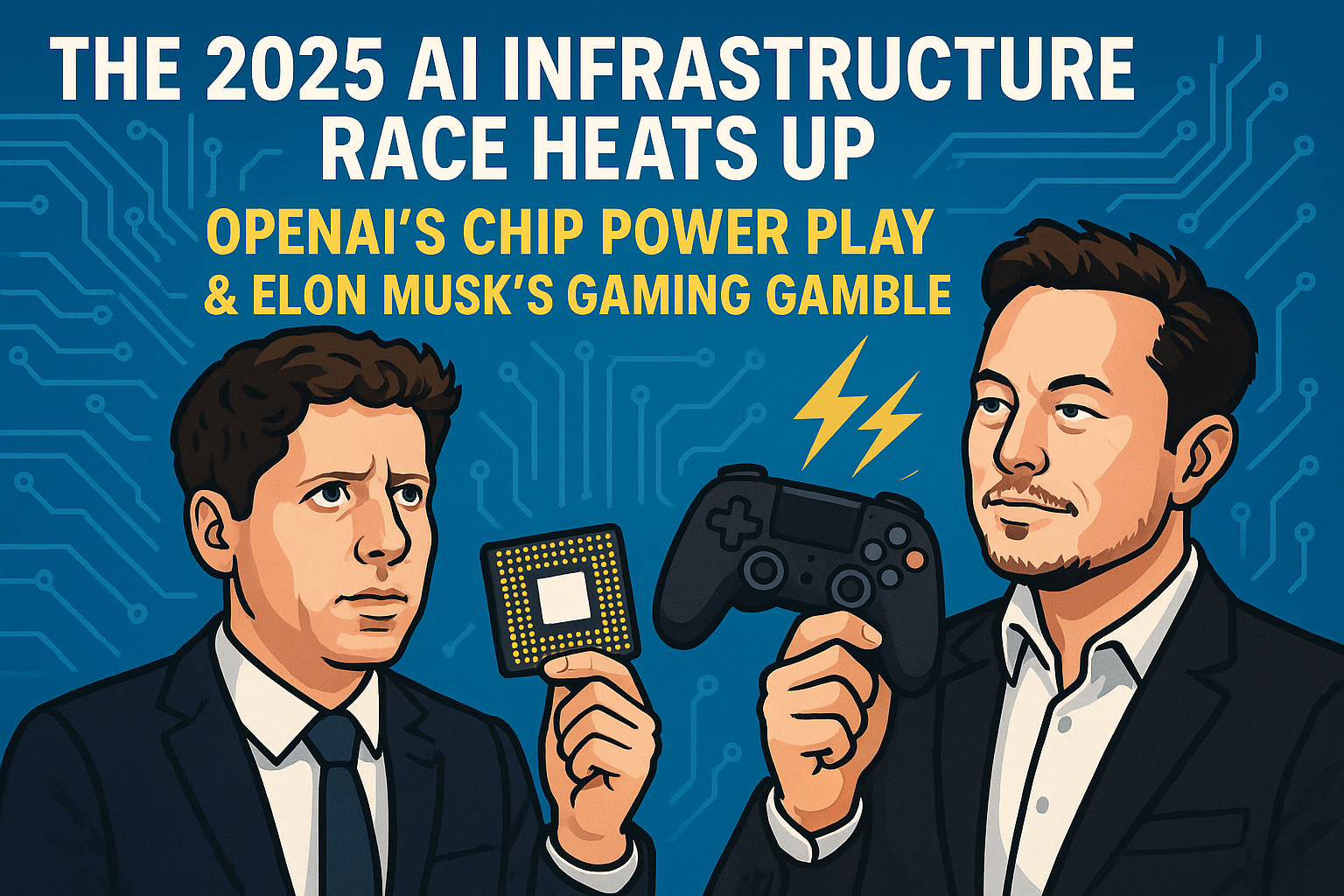
Forget slow tech evolutions. October 2025 is witnessing a high-stakes, trillion-dollar AI arms race that’s reshaping the future of how AI is built and played with. Highlighting this frenzy is OpenAI’s announcement of its third major chip deal, this time with semiconductor heavyweight Broadcom, to co-design custom processors tailored specifically for AI inference — the brainwork behind every ChatGPT reply you get. This move marks the first time OpenAI is diving into producing bespoke silicon, supercharging its computing power and locking in over 26 gigawatts of compute capacity through deals with Nvidia, AMD, and now Broadcom (Om Shree, Future, Oct 13, 2025).
Meanwhile, Elon Musk isn’t sitting on the sidelines. His AI startup, xAI, is boldly stepping into the video game industry, harnessing “world models” — AI systems trained to understand virtual physical environments. Musk, ever the gamer himself, is betting big on a $200 billion sector, aiming to challenge gaming giants by developing AI-powered immersive experiences that could redefine what games mean in 2025 and beyond (Om Shree, Future, Oct 13, 2025).
OpenAI’s partnership with Broadcom signals a new era of AI-specific silicon design. Unlike general-purpose processors, these custom AI chips are optimized to handle inference tasks — the real-time calculations needed to interpret user requests and whip up intelligent responses. The stakes are high: with AI workloads exploding, off-the-shelf chips can’t keep up, pushing companies like OpenAI to create their own hardware tailored for optimal AI performance and energy efficiency.
Tech analysts note this is an industrial-scale race with effects rippling across Microsoft, Google, and Meta, all who are now scrambling to boost their own compute infrastructure spending. This infrastructure arms race isn’t subtle — it’s reshaping capital flows in Silicon Valley, signaling that whoever controls the hardware also controls AI’s future (Om Shree, Future, Oct 13, 2025).
Elon Musk’s AI experiment, xAI, is targeting the gaming industry — a bold expansion that’s surprising yet totally fitting for the tech billionaire. xAI aims to use world models, AI trained to comprehend and interact within physical-like environments, to create games that aren’t just scripted but live and evolving. Think AI-powered game worlds that learn, adapt, and surprise players in ways static code simply can’t.
This is a fresh twist in Musk’s tech narrative: from PayPal to Tesla to SpaceX, and now xAI challenging the trillion-dollar AI and gaming markets in one sweep.
Biotech firm FYR is leveraging CIQ’s Fuzzball supercomputing platform for AI-driven multiomic analysis, accelerating biomarker discovery and drug development. This signals AI’s widening scope beyond consumer tech into personalized healthcare, reshaping how science tackles diseases (AI Insider, Oct 10, 2025).
Intel unveiled next-gen 18-angstrom chips promising enhanced performance and efficiency, signaling its push to regain ground in the semiconductor race dominated by Nvidia and AMD (TST Technology, Oct 2025).
Slack announced major AI upgrades to Slackbot, its assistant, aiming to supercharge workplace productivity with smarter, context-aware features — a taste of AI integration becoming standard in business tools (TechRadar, Oct 15, 2025).
OpenAI’s major custom chip partnership with Broadcom marks a historic leap into AI hardware, scaling to an unmatched 26+ gigawatts of compute power. Meanwhile, Elon Musk’s xAI is charging headfirst into the $200B gaming arena with AI-driven immersive worlds. October 2025 is the month when AI infrastructure and gaming took giant, intertwined leaps into the future. Plus, AI is quietly revolutionizing healthcare, chips, and business tools — and it’s only getting started.