By Ryan | July 14, 2026 | NXPC
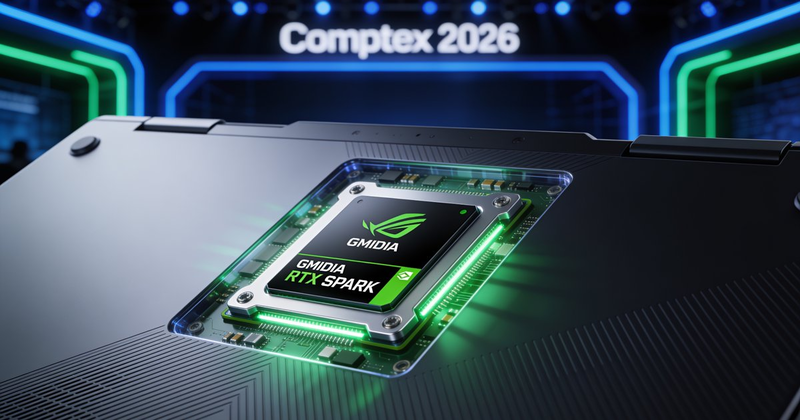
If Computex 2026 taught us anything, it's this: Nvidia just kicked in the front door of the PC processor market, and nobody saw the battering ram coming.
I've been covering PC hardware for years, and I've never seen Wall Street react to a keynote the way it did on June 1. Within hours of Jensen Huang walking off stage after unveiling the RTX Spark Superchip, Intel shares dropped over 4%, AMD slid 5%, and Qualcomm tumbled more than 6%. Arm Holdings? Straight up. The market doesn't lie — it just priced in an existential threat to four decades of x86 dominance.
So what exactly is this thing, and should you care? Grab a coffee. Let's dig in.
At its core, the RTX Spark Superchip is an Arm-based system-on-chip (SoC) that Nvidia co-developed with MediaTek. It marries a 20-core CPU (10 performance Cortex-X925 cores + 10 efficiency Cortex-A725 cores) with a full Blackwell RTX GPU packing 6,144 CUDA cores and 5th-gen Tensor Cores with FP4 precision. The whole thing is lashed together via Nvidia's NVLink-C2C interconnect and fed by up to 128GB of unified LPDDR5X memory at roughly 300 GB/s.
Translation: it's a data-center-grade AI accelerator crammed into a laptop SoC.
| Component | RTX Spark N1X (Flagship) |
|---|---|
| CPU | 20-core Arm (10× X925 + 10× A725) |
| GPU | Blackwell RTX, 6,144 CUDA cores |
| Tensor Cores | 5th-gen, FP4 precision |
| Unified Memory | Up to 128GB LPDDR5X |
| Memory Bandwidth | ~300 GB/s (NVLink-C2C) |
| AI Performance | Up to 1 petaflop (FP4) |
| Power Envelope | 45-80W |
| OS | Windows on Arm (with Microsoft) |
There are three tiers: the flagship N1X (above), a mid-tier N1 (12 cores, 2,560 CUDA cores, 18-45W), and an entry N1 (10 cores, 2,048 CUDA cores). Nvidia's playing the same segmentation game as everyone else — they just started at the top and are working down.
Here's where things get spicy. According to Nvidia, a top-spec RTX Spark machine can run a 120-billion-parameter LLM locally with a million-token context window. On a laptop.
Let that sink in. A 120B model at FP4 quantization eats roughly 60GB of memory — impossible on a 16GB gaming notebook. With 128GB unified memory, it not only fits but leaves headroom for the KV cache and OS. For developers and researchers, that means running frontier-class open models like Llama 3.3 70B or Qwen 3 235B (at lower quant) without a cloud bill.
Nvidia also claims you can:
All on the same chip. With DLSS 4.5, CUDA, TensorRT, OptiX, Reflex, and G-SYNC all baked in. This isn't just an AI chip — it's an everything chip.
Here's where I pump the brakes a little. Rich Edmonds over at XDA put it perfectly: Nvidia is optimizing for the edge case and marketing it as the mainstream.
I've been running 7B and 13B models on modest hardware for months, and honestly? It fits my workflow. Summarization, light coding help, home automation — none of it needs 120B parameters. AMD's Ryzen AI Max+ 395 with 128GB unified memory on x86 delivers perfectly usable numbers: 29.84 tok/s on a 9B model, 42 tok/s on a 35B MoE, and even 8.59 tok/s on a 122B MoE with Qwen 3.5. That's genuinely usable local AI at what will likely be a much friendlier price point.
The RTX Spark is a developer's dream — but it might be overkill for the rest of us. At least for now.
That said, Nvidia has done this before. When RTX launched in 2018 with ray tracing, everyone said it was overkill. Now ray tracing is table stakes. RTX Spark could seed the local AI ecosystem the same way. The hardware comes first; the use cases follow.
Nvidia hasn't published official pricing, but PCWorld's Alaina Yee got the scoop from Computex floor sources and analyst chatter:
| Tier | Estimated Starting Price |
|---|---|
| N1X Flagship | $2,500 – $2,899 |
| N1 Mid | ~$2,000 |
| N1 Entry | ~$1,799 |
These are MacBook Pro prices, not Dell Inspiron territory. The first wave of RTX Spark machines — from ASUS (ProArt P14 and P16), Dell, HP (OmniBook Ultra 16), Lenovo, Microsoft Surface (Laptop Ultra + Dev Box), and MSI — are squarely aimed at creators, developers, and AI enthusiasts with deep pockets. Acer and Gigabyte join later.
Microsoft and Nvidia reps deflected pricing questions at Build 2026, but one source confirmed: everyone's waiting to see how memory and storage component prices shake out by fall. Either way, $1,800 as the floor means mainstream adoption is a 2027-2028 story.
Nvidia walking onto Intel and AMD's turf doesn't mean those two are standing still:
The wildcard is CUDA. It remains the default mental model for GPU acceleration, and RTX Spark comes with the full Nvidia software stack. AMD's ROCm is improving fast, but the ecosystem gap is real.
Look, I'm a hardware reviewer, not a stock analyst. But even I can feel the tectonic shift here. The RTX Spark isn't just another chip launch — it's Nvidia planting a flag in the consumer PC market and saying, "We're here now. Deal with it."
For my fellow experimenters out there — the people who love spinning up local LLMs, pushing hardware to its limits, and finding out "what happens if we try this" — the RTX Spark is genuinely exciting. A laptop that can hold a 120B model in memory and game at 1440p 100+ FPS? That's the silicon lottery jackpot.
For everyone else? Wait for the reviews. The N1 entry tier at ~$1,799 might be the sweet spot once real-world benchmarks land. And keep an eye on AMD — the Ryzen AI Max+ is no slouch, especially if you value x86 compatibility and a more modest power bill.
Fall 2026 can't come fast enough. I'll be first in line to benchmark one of these beasts. 🖥️🔥
All the research that went into this piece:
YouTube Coverage: