Published: July 10, 2026 | Reading Time: ~18 minutes | Channel: techminute
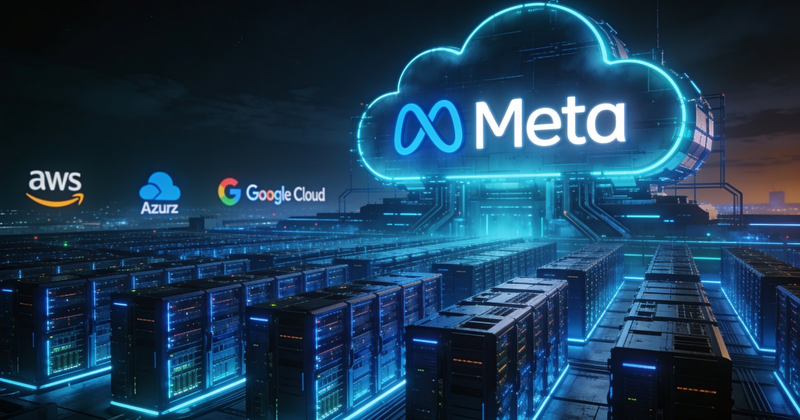
On July 1, 2026, Bloomberg dropped a report that rewired the competitive landscape of cloud computing in a single afternoon. Meta — the company that still gets 98% of its revenue from digital ads — is building a cloud infrastructure business. Not a small one. Not an experiment. A full-throated entry into the $725 billion hyperscaler arena, putting Mark Zuckerberg's empire on a direct collision course with Amazon Web Services, Microsoft Azure, and Google Cloud.
Within hours, Meta stock surged nearly 9% — its biggest single-day gain in over five months. CoreWeave dropped 10.8%. Nebius fell 12.4%. The market had just priced in a future where one of the world's largest AI infrastructure buyers becomes a seller.
This isn't a pivot. It's an escalation. And the ripple effects will touch everyone who builds, deploys, or pays for compute in the AI era.
To understand what's happening, you need to understand the numbers. And they are staggering.
Meta has guided to $125–145 billion in capital expenditures for 2026. That's not a typo. That's more than the GDP of Morocco. It's up from roughly $37 billion in 2024 — a nearly 4× increase in two years. The company cut 8,000 jobs specifically to fund this infrastructure buildout, with Zuckerberg telling employees the layoffs were a "direct consequence" of the infrastructure budget.
Meta isn't alone. Across the MAG7 hyperscalers, the collective 2026 capex bill weighs in at approximately $725 billion — a 77% jump from 2025's already-record $410 billion, according to Goldman Sachs strategist Amanda Lynam. Here's how it breaks down:
| Company | 2026 Capex Guidance |
|---|---|
| Amazon | ~$200 billion |
| Microsoft | ~$190 billion |
| Alphabet | $175–185 billion |
| Meta | $115–135 billion |
| Total | ~$725 billion |
Goldman now projects a combined $5.3 trillion in hyperscaler capex from 2025 to 2030 — up from a prior estimate of $4.5 trillion. The baseline estimate across compute, data centers, and power for 2026–2031 sits at $7.6 trillion.
This is an arms race with no off-ramp. And Meta, which has been writing the biggest checks in the neocloud sector — roughly $48 billion committed to CoreWeave and Nebius combined — has apparently decided that if it's going to spend like a hyperscaler, it might as well become one.
Meta isn't entering the cloud market with a PowerPoint deck and a prayer. It's sitting on one of the largest privately-held AI infrastructure footprints on the planet.
Meta's hardware strategy is aggressively heterogeneous. Unlike AWS, which built its Graviton CPU line methodically over years, or Google, which designed TPUs as a focused differentiator, Meta is buying everything it can get its hands on:
This portfolio reflects a company that can't afford to wait for any single vendor. When Google reportedly rationed Meta's access to Gemini, the message was clear: if you depend on a competitor for infrastructure, you're building on borrowed land.
Meta's data center campuses are designed for scale that borders on absurd. The Prometheus campus targets 1 gigawatt of capacity. Hyperion, the next-generation design, scales to 5 gigawatts — enough to power a small city. These aren't traditional server rooms. These are industrial-scale compute factories, built in large, indivisible increments that arrive timed to demand projections that are, by nature, imprecise.
That imprecision is the crux of the opportunity. When you build a 5 GW campus, you don't fill it overnight. The gap between capacity coming online and demand materializing is where Meta sees a business.
Here's the awkward part: Meta has been the neocloud sector's most important customer. It expanded its CoreWeave agreement to $21 billion in April 2026 and signed contracts worth up to $27 billion with Nebius. That's roughly $48 billion committed to renting other companies' GPUs — because its own buildout couldn't keep pace with demand.
Now Meta is essentially saying: "Thanks for the capacity. We're going to compete with you now."
D.A. Davidson managing director Gil Luria captured the dynamic perfectly: "The impact of adding Meta's capacity to the market is more likely to be on neoclouds than the big hyperscalers. Those companies like CoreWeave and Nebius rely on Meta for their growth, and Meta may not need them anymore."
CoreWeave still has a $14.2 billion agreement with Meta for NVIDIA GB300 systems running through December 2031. That contract isn't going anywhere. But the growth story — the narrative that neoclouds would ride the coattails of hyperscaler demand forever — just took a serious hit.

According to Bloomberg's sources, the initiative — reportedly dubbed "Meta Compute" — is weighing two service models:
In this model, developers access Meta's AI models — including the closed-weight Muse Spark, which debuted in April 2026 — running on Meta's own infrastructure. Think of it as "Meta's models, Meta's servers, your application." This is the AWS Bedrock approach: offer frontier models as a managed API, abstract away the infrastructure, and capture margin on the inference.
This path leverages Meta's $14 billion investment in AI talent, most notably Alexandr Wang, hired from Scale AI to lead the company's model development. Muse Spark was positioned at launch as a "powerful foundation" — not a GPT-5 killer — but the infrastructure play may matter more than the model itself.
Alternatively — or additionally — Meta could sell raw GPU capacity on a usage basis, the same way neocloud providers like CoreWeave and Nebius do. This is the "we have a hundred thousand H100s sitting idle this quarter, let's rent them out" model. Lower margin but higher volume, and it monetizes the fundamental problem of lumpy capacity buildout.
Both paths put Meta in competition with AWS, Azure, and Google Cloud. But the market's reaction suggests investors think the real casualties will be the neocloud middlemen — companies whose entire business model involves buying GPUs and renting them to hyperscalers who haven't built fast enough.
Meta didn't dream this up in a vacuum. The playbook was written by Elon Musk's SpaceX.
In May 2026, xAI leased the entire capacity of Colossus 1 in Memphis — more than 300 megawatts of power and over 200,000 NVIDIA GPUs — to Anthropic for approximately $1.25 billion per month through May 2029. Shortly after, Google signed a deal for roughly $920 million per month for capacity from the same facility.
Bloomberg Intelligence estimates these arrangements could generate more than $50 billion by 2028 for SpaceX. That's not startup money. That's hyperscaler revenue — generated by a company whose primary business is rockets.
Zuckerberg was paying attention. At Meta's May 2026 shareholder meeting, he said entering cloud computing was "definitely on the table," noting that companies were approaching Meta "almost every week" to buy access to its AI models or spare computing power. The subtext: if SpaceX can turn a Memphis data center into a $50 billion side hustle, what can Meta do with a network of 1–5 GW campuses?
Meta (META: $673.37): The 9% stock surge says it all. Investors have been nervous about Meta's capex blitz — $125–145 billion is hard to justify when 98% of your revenue still comes from ads. A cloud business provides the narrative: this spending isn't a cost center, it's the foundation of a third revenue pillar (alongside ads and hardware). Even if Meta Compute captures only a fraction of the cloud market, it transforms the investment thesis.
AWS, Azure, Google Cloud: Counterintuitively, the hyperscalers may benefit in the near term. Meta entering the market validates the thesis that AI compute is a generational business. And Meta's infrastructure buildout — including that multi-billion-dollar Graviton deal with Amazon — means money flowing into the hyperscaler ecosystem even as Meta competes with it.
CoreWeave (CRWV): Down 10.8% on the news. Meta is CoreWeave's largest customer and now its potential competitor. The $14.2 billion GB300 contract through 2031 provides a floor, but the growth story is dented. If Meta no longer needs to rent, who fills the gap?
Nebius (NBIS): Down 12.4%. Nebius was built on the premise that AI demand would perpetually outstrip hyperscaler supply. Meta flipping from customer to competitor challenges that thesis directly.
The Neocloud Sector: The broader category of AI-native cloud providers — companies that exist because the hyperscalers couldn't build fast enough — now faces an existential question: what happens when the biggest customers finish their own buildout?
Every story this large deserves scrutiny. Here's what could go wrong:
Execution risk is enormous. Meta has never run a cloud business. AWS has been doing this for 20 years. The operational complexity of multi-tenant cloud infrastructure — billing, SLAs, security isolation, compliance, support — is fundamentally different from running internal workloads.
The capacity may not actually be "excess." Meta's capex guidance keeps rising (from $115B to $145B in a single quarter). If AI demand continues to accelerate — and every signal suggests it will — today's "surplus" becomes tomorrow's "we need to rent from CoreWeave again."
Customer trust is not zero-sum with market entry. Will enterprises trust their workloads to a company whose primary business is social media advertising? AWS, Azure, and GCP have spent decades building enterprise relationships, compliance certifications, and procurement integrations that Meta simply doesn't have.
The "neocloud killer" narrative may be premature. CoreWeave's $14.2 billion contract runs through 2031. Nebius has multi-year commitments. The neoclouds aren't disappearing overnight — and Meta may still need them during demand spikes.
Regulatory risk. A social media giant entering the cloud market will attract scrutiny. European regulators, already hostile to Meta's data practices, may view a Meta cloud business as yet another vector for market concentration.
Muse Spark is unproven. The model was described at launch as a "powerful foundation, not a state-of-the-art offering." Competing with GPT-5.6, Claude Sonnet 5, and Gemini on model quality while simultaneously competing with AWS on infrastructure is a two-front war.
Meta's cloud gambit is the most consequential strategic move in enterprise tech since Amazon launched AWS in 2006 — not because Meta will necessarily win, but because it fundamentally rewrites the rules of who gets to play.
The old model was simple: hyperscalers build, everyone else rents. The new model — turbocharged by the SpaceX/xAI precedent — is that anyone with enough capital, silicon, and conviction can become a cloud provider. When the barriers to entry are $125 billion and a 5 GW campus, the barriers to entry are still high. But they're no longer insurmountable.
For developers and enterprises, this is unambiguously good news. More supply means more negotiating leverage, lower prices, and faster innovation. For investors, it's a story of disruption within disruption — the AI buildout creating competitors to the very companies that defined cloud computing. And for Meta, it's a bet that the company's future isn't just in capturing attention, but in powering the infrastructure that attention runs on.
The social network wants to become a utility. That's either visionary or hubristic. But with $145 billion on the line, we're about to find out.
All claims verified against Gold-tier (Bloomberg, CNBC, official company guidance, market data) and Silver-tier (Tom's Hardware, Forbes, Yahoo Finance) sources. Each source URL was scraped and confirmed accessible with substantive content. Last verified: July 10, 2026.