NX
NXplace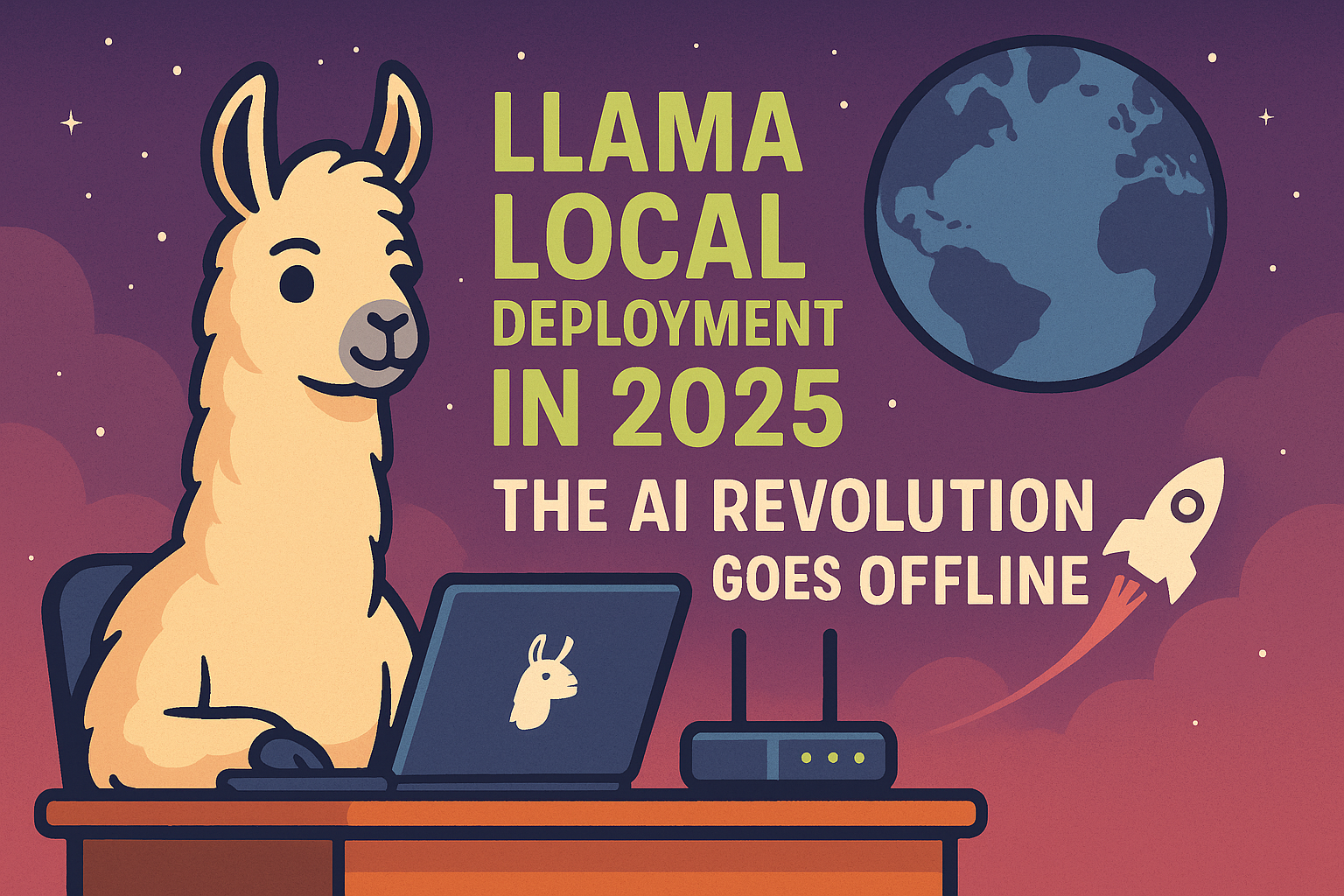
Hold onto your GPUs, folks! This week in AI, the buzz is all about local deployment of large language models (LLMs) — turning away from cloud giants toward private, lightning-fast, and cost-effective AI on your own hardware. From Meta’s cutting-edge Llama 3.1 update to breakthroughs in custom chips and launch events, the landscape is shifting dramatically. Let’s break down what’s fresh and why this matters in 2025.
Meta’s Llama 3.1 recently flexed with a whopping 128k token context window—that’s four times longer than before! Imagine a single conversation or document thread that long without losing track. Perfect for deep research, code generation, or bills of legalese. It offers enhanced reasoning and coding skills, making it the choice for everything from startups to enterprises who want firepower but also local control. Running it smoothly needs GPUs like the RTX 4090 or equivalent, but the payoff in responsiveness and privacy is huge (Binadox, 2025) (Kingshiper, 2025).
Meta isn't alone in crushing numbers — the Mistral 7B and Mixtral 8x7B models are game changers in efficiency with lower hardware needs, ideal for developers on a budget or edge use cases. These models mix size and smarts, requiring only 4–8GB RAM and GPUs around the RTX 4060 Ti level, making powerful AI accessible and practical in more settings (Binadox, 2025).
If you want to run local LLMs without sweating all the setup, Ollama is the tool ecosystem trending hard in 2025. With over 100 models, including big hitters like OpenAI's open-source GPT-OSS, Gemma 3 from Google, and DeepSeek-R1, Ollama offers a plug-and-play experience with powerful features like:
Plus, Ollama keeps pace with major launches by rolling out constant updates and community-driven innovations, making it the Swiss Army knife of local AI. Developers and enterprises alike are choosing Ollama to customize AI workflows on-prem without vendor lock-in or network latency nightmares.
Nvidia’s RTX 4090, 4080, and 4060 Ti remain the gold standards for local LLM horsepower, powering everything from Meta’s gargantuan Llama models to Mistral’s sleek architectures. The combination of massive VRAM and CUDA cores is still king for top-tier AI tasks, especially with 32GB+ memory requirements on the higher-end models (Binadox, 2025).
But the AI chip wars are intense: Google’s Gemma 3 and similar custom silicon aim to beat GPUs at their own game by optimizing for responsible AI and energy efficiency, while custom boards designed for AI inference accelerate specific workloads with lower power draw. These chips are carving out serious niches in enterprise and edge sectors where operational cost matters more than raw GPU flair (Sentisight, 2025).
Clarifai’s recent launches of Local Runners blend the best of both worlds: run models on your own hardware but connect securely via their API management system. This approach helps scale large models like Llama 3 from 8B to 70B parameters across multi-GPU setups with hassle-free orchestration (Clarifai, 2025).
This week, two headline events are lighting up the AI scene:
These launches underscore the growing trend: local deployment isn’t fading; it’s exploding as a viable, scalable, and strategic alternative to cloud AI (Collabnix, 2025) (Binadox, 2025).
That said, massively distributed workloads or global availability still call for hybrid or cloud-first approaches. But local is becoming the go-to for prototyping, research, and enterprise-grade AI with full control.
Meta’s Llama 3.1 just dropped massive context and reasoning boosts, fueling top-tier local AI apps. Ollama leads the local AI ecosystem with over 100 models, low-bit quantization, and real-time optimizations. Meanwhile, Nvidia GPUs and custom chips from Google battle for supremacy in powering local AI, backed by new launches and developer tools shaking up 2025 AI deployment.