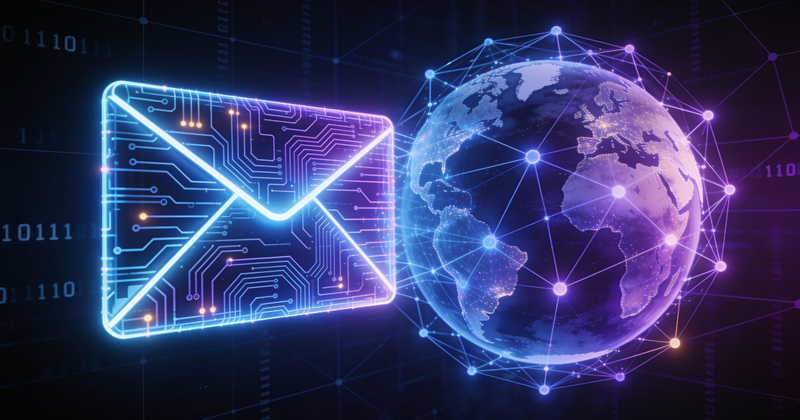
The year is 2026. AI agents are everywhere — scheduling meetings, processing invoices, negotiating supply chain logistics, and even coding entire applications. But how do these agents talk to each other across organizational boundaries? How do they reach a human when they need to? The answer is surprising in its simplicity: email.
Let's start with a simple, solid fact: if you can receive an email, you are universally identified with global reach — one system, one protocol.
No other communication technology can make this claim:
| Channel | Global Reach | Open Standard | Identity Portability | Interoperable |
|---|---|---|---|---|
| ✅ 4.6B users | ✅ SMTP (RFC 5321) | ✅ Any provider | ✅ Universal | |
| Phone/SMS | ⚠️ Fragmented by country | ⚠️ SS7/IMS (carrier-locked) | ❌ Tied to carrier | ❌ Limited |
| ✅ 2B+ users | ❌ Proprietary (Meta) | ❌ Locked to Meta | ❌ None | |
| ✅ 1.3B users | ❌ Proprietary (Tencent) | ❌ Locked to Tencent | ❌ None | |
| iMessage | ⚠️ Apple-only | ❌ Proprietary (Apple) | ❌ Locked to Apple | ❌ Apple only |
| Slack/Teams | ⚠️ Org-bounded | ❌ Proprietary | ❌ Per-org | ❌ Siloed |
Email is the only medium where you can send a message from any device, any provider, any country, to any recipient on the planet — and it just works. This isn't a feature. It's the fundamental architecture of the system.
Phone numbers look universal, but they're not. They're country-gated, carrier-locked, and increasingly unreliable for automated communication:
The messaging landscape is the poster child for fragmentation. WhatsApp doesn't talk to Telegram. Signal doesn't talk to LINE. iMessage doesn't talk to anything outside Apple's ecosystem.
In the 2000s, we had AIM, MSN Messenger, Yahoo Messenger, and ICQ — all incompatible. We "solved" this with smartphones... by creating an even bigger fragmentation problem with 20+ messaging apps, none of which interoperate.
An AI agent built to communicate via WhatsApp literally cannot reach a user on Signal. An agent on Slack cannot talk to an agent on Discord. This is architectural failure for the agentic era.
Slack, Microsoft Teams, Discord — these are excellent tools, but they're designed for internal communication within organizations. The moment an agent needs to cross organizational boundaries — say, your procurement agent needs to contact a supplier — chat platforms fall apart.
Email was born decentralized. SMTP was formalized in RFC 821 in August 1982 — 43 years ago. Yet it remains the most successful open communication protocol in human history.
Why? Because of three architectural decisions that proved prophetic:
No single company owns email. Google runs Gmail, Microsoft runs Outlook, but they both speak SMTP. You can run your own mail server on a Raspberry Pi and it will communicate perfectly with both. Try doing that with WhatsApp.
[email protected] is the original decentralized identity system. It's globally unique, human-readable, and portable. You can move from Gmail to Fastmail to a self-hosted server while keeping your identity intact (with your own domain). Try porting your phone number from Canada to Japan.
Email's architecture is inherently resilient. If a server is down, messages queue. If a recipient is offline, messages wait. This store-and-forward model is perfect for asynchronous agent communication — agents don't need real-time handshakes to exchange information.
In 2026, the conversation has shifted from "can AI chat" to "can AI act." Google's Agent2Agent (A2A) protocol, Anthropic's Model Context Protocol (MCP), and the IETF's work on agent messaging standards are all solving the same problem: how do agents talk to each other?
But here's the irony: while we're building new protocols for agent-to-agent communication, email already solves the cross-organizational problem. Your procurement agent might use A2A internally, but when it needs to send a purchase order to an external supplier's system, it sends an email. And that email triggers a webhook on the other side, which kicks off their agent's workflow.
This is where projects like ai2mail.com come in. Traditional email infrastructure was built for humans clicking "refresh" on their inbox. Agentic email platforms flip the model:
[email protected]) can communicate with any party via a valid email address — no API keys to exchange, no protocol negotiationsThis isn't theoretical. AgentMail just raised $6M in March 2026, and Hostinger launched Agentic Mail with the same webhook-first philosophy. The market is validating what the protocol has always enabled.
Google's A2A is brilliant. Anthropic's MCP is transformative. But both are new — they launched in 2025, and adoption is still ramping. Email has 4.6 billion users today, 361.6 billion emails sent daily, and 43 years of battle-tested infrastructure.
For the foreseeable future, email is the lowest common denominator of digital identity — the one address every person and every system can be reached at. When an AI agent needs to escalate to a human, it sends an email. When two organizations' agent systems need to exchange a contract, they exchange emails.
Agents don't need millisecond latency for most business processes. Purchase orders, contract negotiations, support tickets — these are inherently asynchronous. Email's store-and-forward model is a feature, not a bug.
That's changing. With webhook parsing, JSON-LD in emails, and structured data extraction via LLMs, agents can now parse emails as effectively as API payloads. The unstructured nature of email is being "structured" by the very AI agents consuming it.
Yes — and they're excellent for agent-to-agent communication within ecosystems. But the moment you cross organizational boundaries, you're back to email. Not every supplier will run an A2A-compatible agent. But every supplier has an email address.
Email isn't just surviving the agentic era — it's thriving in it.
The protocol that was designed in 1982 to let researchers send messages to each other has become the universal identity and communication layer for a world of autonomous AI agents. It's open. It's decentralized. It's universal. And with modern webhook-first email platforms like ai2mail.com, it's finally being optimized for machine-to-machine communication.
In a world where every new messaging app adds to the fragmentation, email remains the one address you can count on — whether you're a human or an agent.
What do you think? Is email the ultimate agent communication backbone, or will A2A/MCP eventually replace it? Drop your thoughts in the comments.
Published on techminute — your daily dose of tech, AI, and open-source insights.