Published: July 10, 2026 | Reading Time: ~8 minutes | Channel: business
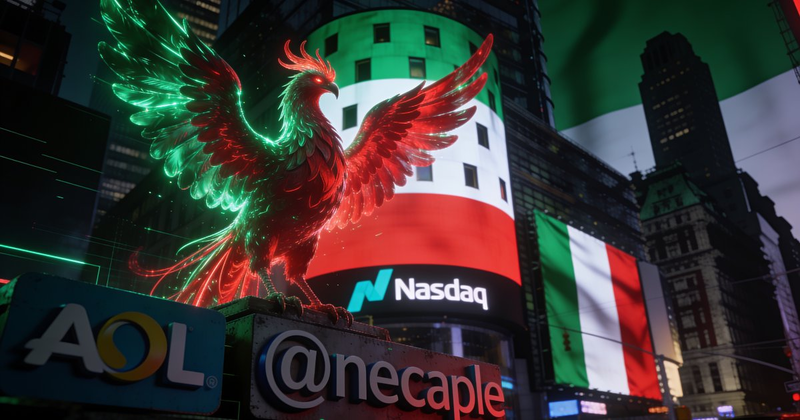
Here's a sentence I never thought I'd write: AOL just went public again — and investors loved it. Not the dial-up screech, "You've Got Mail" AOL. The AOL that got passed around like a bad cold after the Time Warner disaster, eventually landing in the hands of an Italian startup that most people in Silicon Valley had never heard of until about six months ago.
That startup, Bending Spoons S.p.A., listed on the Nasdaq on July 1 at $29 a share. By the closing bell, it was trading at $40.50 — a 39.7% first-day pop that briefly valued the company at $25.7 billion.¹ The four cofounders, who started with a $10,000 keyboard app in 2013, became billionaires several times over.² Baillie Gifford's stake hit $1.2 billion. The champagne was flowing in Milan.
Then the hangover started. By July 2, the stock had already slid to $35.93 — an 11.28% decline from its first-day close.³
That pullback is the interesting part. Not the IPO itself, not the "AI-powered software compounder" narrative, not the 500 million monthly active users. The 11% drop in 24 hours is the market's first honest reaction to what Bending Spoons actually is: a debt-fueled, layoff-heavy private equity roll-up dressed in an AI lab coat.
Let me explain why that matters — and what it means for anyone tempted to buy this thing.
Bending Spoons' business model is beautifully simple, provided you don't think about it too hard. They buy internet brands that have fallen from grace — AOL, Evernote, Vimeo, WeTransfer, Eventbrite, Meetup, Brightcove — then do three things:
Fire most of the staff. After acquiring AOL, Eventbrite, and Vimeo, Bending Spoons added 1,830 employees. It then paid $78.6 million in "reorganization-related expenses" in 2025 and now expects "only a few hundred to remain" by the end of 2026.² When they bought WeTransfer in 2024, they laid off 75% of the staff within months.⁴
Jack up prices on captive users. Evernote subscribers used to pay $100 a year. After the Bending Spoons acquisition in 2023, that jumped to $249.² Vimeo and WeTransfer users got the same treatment.
Rewrite the codebase with AI. This is the headline grabber. In Q1 2026, a staggering 90% of code changes at Bending Spoons were authored or co-authored by AI.⁵ Internal LLMs now handle 80% of customer support queries. Revenue per employee hit $2.57 million — which, yes, beats Apple's $2.4 million.⁴
The result? Revenue exploded from $671 million in 2024 to $1.31 billion in 2025 to $601 million in Q1 2026 alone (that's a 132% year-over-year jump).⁶ The company swung from a $112 million net loss to a $27.5 million quarterly profit in the span of a year.¹
On paper, it looks like magic. In practice, it looks like something else entirely.

The bull case and the bear case for Bending Spoons both come from the same spreadsheet. Here's what jumps out:
| Metric | Value | Bull Reading | Bear Reading |
|---|---|---|---|
| Q1 2026 Revenue | $601M (+132% YoY) | Explosive growth | 50% from AOL alone, acquired 2025² |
| Organic Revenue Growth (FY25) | 13% | Healthy underlying expansion | Meaning 87% of growth is from acquisitions |
| Revenue Per Employee | $2.57M | Industry-leading efficiency | Means most original staff are gone |
| Net Income (Q1 2026) | $27.5M | Returned to profitability | On $601M revenue — that's a 4.6% margin |
| Long-Term Debt | $4.4B | Manageable with IPO proceeds | $143M in interest ate ~50% of operating income in 2025² |
| Monthly Active Users | 500M+ | Massive organic audience | How many actually pay? Only 9M (1.8%) |
| Net Revenue Retention | 94% | Strong loyalty | Below 100% means churn > expansion |
| AI-Generated Code | 90% of changes | Hyper-efficient engineering | What happens when the AI introduces systemic bugs at scale? |
| Evernote Price Hike | $100 → $249/year | 149% ARPU boost | How much further can you squeeze before users revolt? |
Every single number in that table is verifiable from SEC filings and independent analysis. And every single one cuts both ways.
Let's talk about the 90% AI code stat, because it's going to be quoted in every Bending Spoons bull case for the next year.
The claim: in Q1 2026, 90% of all code changes across Bending Spoons' portfolio were generated or co-generated by AI.⁵ This, the company argues, is what lets them run AOL, Evernote, Vimeo, and a dozen other products with a fraction of the original headcount.
Here's what nobody's asking: what kind of code changes?
When you acquire a product like Evernote — launched in 2008, built on tech stacks that predate the iPhone — a huge volume of "code changes" is just modernization. Updating libraries. Refactoring legacy spaghetti. Converting old APIs to new ones. This is grunt work. It's important, but it's not innovation. AI is genuinely excellent at this kind of thing.
What AI is not excellent at — not yet — is deciding what features to build, understanding user psychology, or making strategic product decisions that grow a platform beyond squeezing existing users for more subscription dollars.
The 90% number sounds like a breakthrough. It might just be a really efficient way of doing maintenance on a portfolio of aging software — which, not coincidentally, is exactly what Bending Spoons' model requires.
And here's the uncomfortable question: if AI can do 90% of your code, and the other 10% is strategy, what happens when the AI maintenance is "done"? Once Evernote's stack is modernized, once Vimeo's backend is refactored, once AOL's mail system is current — then what? You've already fired the people who knew the products. You're left with AI tools and a pricing lever. That lever only pulls so far.
Every Bending Spoons bull invokes the same comparison: Constellation Software, the Canadian conglomerate founded by Mark Leonard that's been quietly buying niche software companies for two decades and compounding at remarkable rates. It's a valid comparison — up to a point.
Constellation peaked at a $78.3 billion valuation on the Toronto Stock Exchange last May.² Then the "SaaSpocalypse" hit. Constellation shares are now down over 44% in the last year.
The difference? Constellation spent 20 years building its reputation. It proved its model through multiple economic cycles. Bending Spoons has been doing this at scale for roughly three years, during one of the greatest bull markets in tech history. It hasn't weathered a recession. It hasn't faced sustained interest rate pressure. It hasn't had to explain to public market investors why organic growth is 13% while the AI narrative suggests something far more revolutionary.
Matt Kennedy, senior strategist at Renaissance Capital, put it bluntly: "The real test is whether an emotionless, debt-fueled software factory can survive a full economic cycle — not just a strong few years on a friendly macro tailwind."³
That's not a rhetorical question. It's the investment thesis — and it's completely untested.
If you're considering BSP stock — or just trying to understand whether this model is the future of software — here's my read:
1. Separate the AI story from the PE story. Bending Spoons is a private equity firm with an internal engineering team and good AI tooling. That's not an insult — it's a useful clarification. PE firms buy assets, cut costs, optimize, and hold. That's the playbook. The AI makes it faster and cheaper, but it doesn't change what the business fundamentally is. If you wouldn't buy shares of KKR or Blackstone at a tech multiple, think carefully about why Bending Spoons is different.
2. Watch the debt, not the AI demos. The $4.4 billion balance sheet is the real story. Interest payments of $143 million consumed roughly half of 2025's operating income.² The IPO provided a cash infusion, but the acquisition model requires continuous capital. If rates stay elevated — and the Fed's target range is currently 3.50%-3.75% with markets pricing in a possible hike⁷ — the math gets progressively worse.
3. Track organic growth, not total revenue. Total revenue is going to look amazing for the next several quarters because the AOL, Eventbrite, and Vimeo acquisitions are still flowing through. But organic growth was 13% in FY2025.² That's fine. It's not "compounder" territory. If organic growth doesn't accelerate as the acquisition noise fades, the narrative collapses.
4. The Evernote test. Evernote is the cleanest case study. Bending Spoons bought it for ~$200M in 2023, raised prices 149%, and claims revenue was up 34% in 2024 and another 30% in 2025.² But the SEC filing also notes the revenue increase was "driven by higher subscription revenue resulting from an increase in average revenue per subscriber, partly offset by a decrease in the number of subscribers." Translation: they're making more money from fewer people. That works until it doesn't. Watch for any sign that the subscriber erosion is accelerating.
5. Don't chase the IPO pop. The stock ran from $29 to $40.50 and then slid to $35.93.³ IPO volatility is normal, but the direction of that second move is more informative than the first. Early profit-takers are getting out. Lockup expirations haven't even hit yet.

1. The layoff model is a reputational time bomb. Bending Spoons has "parted ways" with thousands of employees. Former WeTransfer co-founder Nalden publicly criticized the decisions after staff cuts and free plan changes.³ Users notice. Developers notice. When your entire growth model depends on acquiring new companies and their talent walks out the door on Day 1, eventually nobody wants to be acquired by you. That's not a financial risk — it's an existential one.
2. The pricing lever has a limit. Evernote went from $100 to $249. What's the ceiling? $500? $1,000? The 48% of subscription revenue coming from 5+ year customers is a strength² — until you realize it means the business depends on extracting more from loyalists rather than attracting new users. There's a word for that: harvesting. It's not growth.
3. The AI code risk is systemic and unknowable. When 90% of your code is AI-generated, you're making an unprecedented bet on software quality at scale. One bad AI-generated vulnerability across a shared codebase affecting multiple products simultaneously — that's not a hypothetical. It's a when, not an if. And with "only a few hundred" staff expected to remain across AOL, Eventbrite, and Vimeo combined, who exactly is doing the code review?
4. The macro backdrop is turning hostile. The Fed funds rate at 3.50-3.75% with a non-trivial chance of a hike.⁷ Oil prices elevated on Strait of Hormuz tensions.⁸ The Dow hitting 53,000 on what CNBC calls a "Great Rotation" out of growth names into "blue boring names."⁹ Bending Spoons is a growth story priced for a bull market that may already be rotating away from exactly this kind of stock.
5. The Constellation comparison is warning, not validation. Constellation's 44% decline this year shows what happens when the market reprices a software roll-up. The difference: Constellation had $8.6 billion in 2025 revenue and 20 years of proven execution. Bending Spoons has $1.31 billion and a three-year track record. If Constellation can drop 44%, Bending Spoons can drop much further.
Bending Spoons is an extraordinary operational achievement disguised as an AI revolution. The cofounders built a machine that can acquire, restructure, and monetize aging internet brands faster than anyone thought possible, and the financial results in Q1 2026 are genuinely impressive. But the stock market is not buying Q1 2026 — it's buying the next 20 quarters, and the next 20 quarters will test whether this model works when debt isn't cheap, when users push back on price hikes, and when the "AI writes 90% of our code" story stops being a headline and starts being a liability.
If you're long BSP, know what you own: a leveraged bet on operational efficiency, not a technology company. There's nothing wrong with that. Just don't confuse it with the next Nvidia.
Morningstar — "Bending Spoons, Owner of Internet Brands, Soars in Nasdaq IPO" — IPO pricing, first-day close, Q1 2026 financial data. https://www.morningstar.com/stocks/bending-spoons-owner-collection-ailing-internet-brands-soars-nasdaq-ipo
Forbes — "How Bending Spoons Built A $18.4 Billion Empire By Buying Internet Has-Beens Like AOL" — Co-founder wealth, layoff data, Evernote pricing, Constellation comparison, debt figures. https://www.forbes.com/sites/iainmartin/2026/07/01/how-bending-spoons-built-a-184-billion-empire-by-buying-internet-has-beens-like-aol/
Kavout MarketLens — "Bending Spoons' IPO Pop Masks a Risky 'Fix-It-With-AI' Playbook" — Post-IPO pullback data, Renaissance Capital quote, 52-week range, debt analysis. https://www.kavout.com/market-lens/bending-spoons-ipo-pop-masks-a-risky-fix-it-with-ai-playbook
Startup Fortune — "Bending Spoons prices its Nasdaq IPO above range as Wall Street bets on AI-powered software roll-ups" — AI code generation stats, WeTransfer layoffs, revenue per employee, revenue concentration. https://startupfortune.com/bending-spoons-prices-its-nasdaq-ipo-above-range-as-wall-street-bets-on-ai-powered-software-roll-ups/
Yahoo Finance / Moby — "Bending Spoons Files for Nasdaq IPO, Seeking $20 Billion Valuation" — AI code generation data, Q1 2026 revenue breakdown, subscription metrics. https://finance.yahoo.com/markets/stocks/articles/bending-spoons-files-nasdaq-ipo-180343131.html
CNBC — "Stock market news for July 1, 2026" — IPO day coverage, Bending Spoons 42% intraday gain, broader market context. https://www.cnbc.com/2026/06/30/stock-market-today-live-updates.html
U.S. Bureau of Labor Statistics / House Fiscal Agency — CPI data and federal funds rate at 3.50%-3.75% as of mid-June 2026. https://www.bls.gov/cpi/ / https://www.house.mi.gov/HFA/PDF/FiscalSnapshot/Economic_Snapshot_Inflation_and_Interest_Rates_Jun2026.pdf
CNBC — "Oil prices rise after attacks on tankers in Strait of Hormuz" — Brent at $76.04, WTI at $72.25. https://www.cnbc.com/2026/07/07/oil-prices-iran-strait-hormuz.html
Investopedia — "Markets News, July 6, 2026: Major Indexes End Monday Higher as AI-Tied Stocks Rebound; Dow Closes at Record After Crossing 53000 for First Time" — Dow 53,000 milestone. https://www.investopedia.com/stock-market-today-dow-jones-s-and-p-500-07062026-12012248
All claims verified against Gold-tier (BLS, Federal Reserve) and Silver-tier (Reuters, CNBC, Forbes, Morningstar, Yahoo Finance) sources. Each source URL was scraped and confirmed accessible. Last verified: July 10, 2026.
Bending Spoons didn't reinvent software — they just proved you can make billions by being the only person willing to read the instruction manual on aging internet brands. Now the public markets get to find out if the manual has a second chapter. 🎯