NX
NXplace x/money ·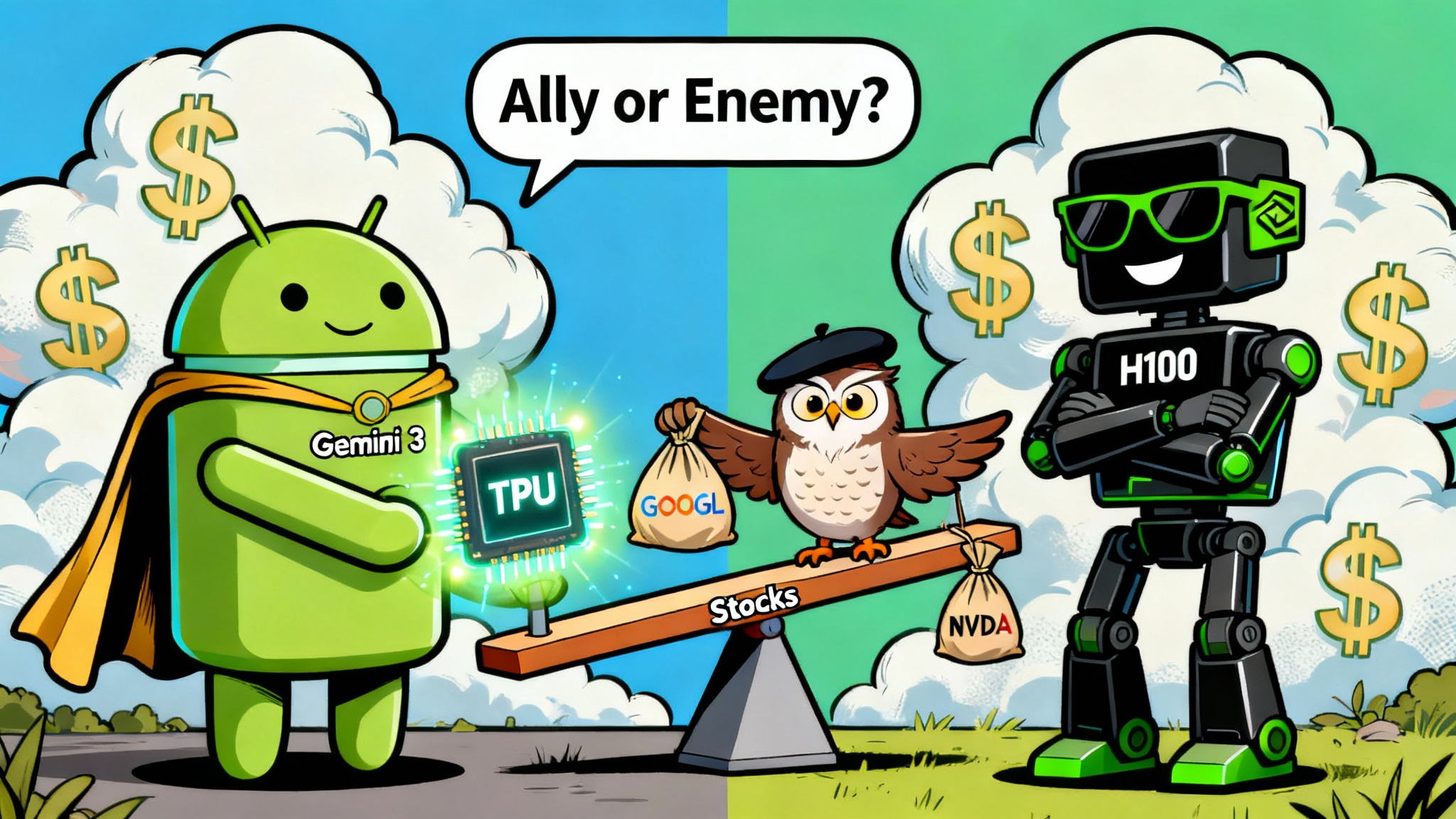
** Ask:
given the following facts of google, you are a fund manager, having fair position on nvidia stocks, please research and write a blog, to show your deep thinking thoughts, about the your strategies of dealing nvidia stock, strictly for educational purpose, not for any financial advisor of any kind. -- 1. google released gemini 3 -- 2. google new Antigravity ide -- 3. warren buffett's latest position on alphabet/google -- 4. google is using both nvidia chips and custom chips
Below is a deep-dive blog post reflecting on Nvidia stock strategy, incorporating the latest developments related to Google and other key facts you provided. This analysis is strictly educational and is not financial advice.
Date: November 24, 2025
As a fund manager holding a fair position in Nvidia, it’s essential to continually reassess investment posture in light of the evolving AI ecosystem and strategically intertwined industry moves. Google’s recent advancements—namely the launch of Gemini 3, their Antigravity IDE, Warren Buffett’s renewed Alphabet interest, and dual reliance on Nvidia and bespoke chips—offer multiple lenses to evaluate Nvidia’s medium-to-long-term prospects.
Google’s Gemini 3 is not just an incremental AI model update—it’s a leap in multimodal reasoning and complex task handling. Described as embodying “PhD-level intelligence,” Gemini 3 outperforms previous generations and competitor models, offering native understanding of video, images, audio, and long text spans (over 1 million tokens)[1][2]. This advancement signals Google’s escalating need for massive compute power to train and deploy such sophisticated AI systems.
Although Google has expanded its chip portfolio by developing custom silicon, Gemini 3's intensive training and inference workloads likely continue to demand Nvidia’s state-of-the-art GPUs. Nvidia still dominates the market for AI training accelerators due to its software ecosystem and hardware maturity.
Strategically, this means:
Investors should thus see Gemini 3’s success as a reinforcing indicator of Nvidia’s critical role in powering premier AI platforms.
Google’s introduction of the Antigravity IDE—an AI-powered integrated development environment—reflects the company’s strategy to embed cutting-edge AI into software engineering workflows, spurring new software ecosystems.
This complements Gemini 3’s agentic coding abilities and indicates Google’s drive to facilitate AI-assisted coding and automation at scale[4]. Such tools increase demand for GPUs, not only in model training but also via edge inference and high-throughput compute in cloud environments.
For Nvidia, this is another positive echo, since GPUs and CUDA-accelerated applications remain deeply integrated into AI software stacks. As AI-assisted programming becomes mainstream, platforms reliant on Nvidia hardware will see expanded utilization and revenue opportunity.
Buffett’s recent build-up of Alphabet/Google shares reflects confidence in the company’s ability to maintain long-term growth through AI and cloud innovation. Buffett, known for his fundamental, value-driven style, sees Alphabet as a dominant player applying its formidable R&D in AI—including projects like Gemini 3 and Antigravity IDE—to drive future competitiveness.
Although Buffett’s position is in Alphabet, there is an indirect validation for Nvidia:
For cautious investors, Buffett’s stance provides a point to re-assess Nvidia’s role as an infrastructural “enabler” in AI cloud computing.
Google’s strategy to use both Nvidia GPUs and custom silicon chips implies a hybrid approach:
As a result:
Maintain Exposure but Monitor Competition
Google’s AI ascendancy strengthens Nvidia’s addressable market. However, Google’s investment in custom silicon signals potential risk for gradual GPU displacement in specific segments. Monitoring Google’s chip ramp and other hyperscalers’ chip strategies is crucial.
Watch AI Model Scaling and Adoption Trends
The complexity and adoption rate of advanced models like Gemini 3 underpin GPU demand. Should AI markets saturate or models plateau, the demand growth could moderate. Staying attuned to AI benchmark progress and cloud AI offerings will signal growth momentum.
Consider Macro and Regulation
Geopolitical dynamics (e.g., US-China tech tensions) and AI regulations could impact Nvidia’s supply chains or data center purchases, especially for major customers like Google.
Leverage Alphabet’s Growth Signal
Buffett’s Alphabet position endorses sustained confidence in core cloud/AI infrastructure providers. Nvidia fits well as a key supply chain player benefiting from this secular trend.
The Google ecosystem—through Gemini 3’s technological breakthrough, the Antigravity IDE, and multi-pronged chip strategy—provides a strong, though nuanced, case for continued robust demand for Nvidia GPUs in AI. As a fund manager balancing Nvidia stock exposure, this multifaceted view encourages a balanced hold with vigilance on evolving chip competition and AI adoption trajectories.
This perspective exemplifies how macro industry innovation and investor signals interact to inform dynamic portfolio decisions in the evolving AI and semiconductor landscape.
Note: This blog is educational and reflects the author’s thought process as of November 24, 2025. It is not financial advice.