Published: July 18, 2026 | Reading Time: ~15 minutes | Channel: techminute
Here's a sentence I didn't expect to write in 2026: AMD just shipped a local AI developer kit that goes toe-to-toe with NVIDIA's DGX Spark on the metric that matters most for everyday use — and it costs $700 less.
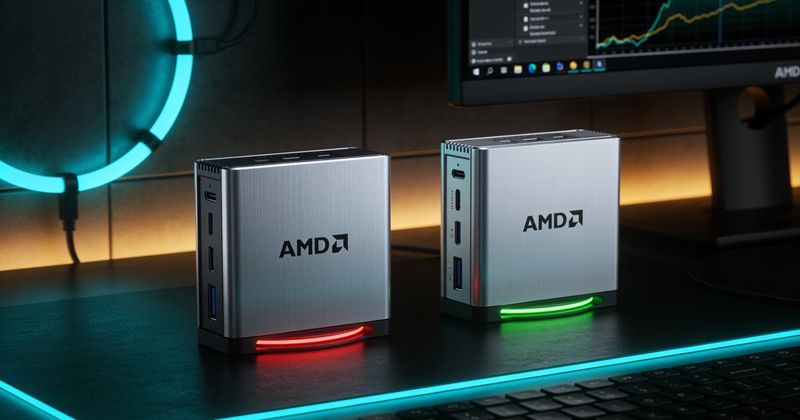
The AMD Ryzen AI Halo Developer Platform hit Micro Center shelves on July 10 at $3,999. It packs the same 128GB of unified memory as NVIDIA's DGX Spark, runs the same class of 120B-parameter models, and — here's the twist — boots Windows 11 natively. Meanwhile, NVIDIA quietly raised the DGX Spark Founders Edition to $4,699, blaming the same LPDDR5X and NAND supply crunch that's been squeezing the entire memory market.
After wading through five independent reviews and benchmark suites, the picture that emerges is more nuanced — and more interesting — than either company's marketing slides would have you believe. This isn't just a spec comparison. It's a referendum on what a local AI workstation should be, and the answer depends entirely on what you're actually going to do with it.
Local AI development used to mean one of two things: cramming a quantized 7B model onto a consumer GPU with 24GB of VRAM, or paying cloud metered rates while praying your agentic coding session didn't accidentally burn through $50 in API calls. The DGX Spark changed that conversation in 2025 by putting a Grace Blackwell superchip and 128GB of unified memory into a box smaller than a hardcover novel.
But NVIDIA's dominance created a vacuum. Developers wanted options — especially developers whose workflows didn't depend on CUDA, or who needed to test on Windows, or who simply wanted a machine that could double as an actual desktop computer. The Mac Studio with its unified memory architecture was one answer, but Apple's decision to stop selling 128GB+ configurations and the limitations of the Metal/MLX software stack made it a half-measure at best.
AMD's Strix Halo APU has been shipping in laptops and third-party mini PCs for over a year. The Ryzen AI Halo Developer Platform is AMD's first official, first-party entry into the category — a signal that the company isn't just letting its OEM partners fight this battle alone.
Let's cut through the marketing and look at the silicon.
| Spec | AMD Ryzen AI Halo | NVIDIA DGX Spark (Founders) |
|---|---|---|
| Price (Jul 2026) | $3,999 (2TB) | $4,699 (4TB) |
| CPU | Ryzen AI Max+ 395 (Zen 5) | GB10 Grace Blackwell |
| Cores | 16C/32T x86, 3.0–5.1 GHz | 20-core Arm (10×X925 + 10×A725) |
| GPU | Radeon 8060S (40 RDNA 3.5 CUs) | Blackwell GPU (1 PFLOPS FP4 sparse) |
| NPU | XDNA 2, 50 TOPS | None dedicated |
| Memory | 128GB LPDDR5X-8000 | 128GB LPDDR5X |
| Bandwidth | 256 GB/s | 273 GB/s |
| Storage | 2TB M.2 2280 NVMe | 4TB (less common 2242 form factor) |
| Networking | 10GbE, Wi-Fi 7, BT 5.4 | 10GbE + ConnectX-7 200G (clustering) |
| OS | Windows 11 or Linux | DGX OS (Linux only) |
| Dimensions | 150×150×45.4mm | Similar 1L form factor |
| Power | 120W via USB-C | ~120W |
| Expansion | Standard M.2 2280 (up to 8TB) | 2242 M.2 (limited aftermarket) |
The spec sheets converge on the thing that makes both of these boxes interesting: 128GB of unified memory accessible to the GPU. That's enough to hold models no single 24GB consumer card can touch — gpt-oss 120B, Qwen3-235B at aggressive quants, or dense 70B models with room to spare for KV cache. Neither box is fast in absolute terms; both are bandwidth-bound at ~256–273 GB/s, roughly a quarter of what a single RTX 5090 pushes. The promise isn't speed. The promise is capacity.
But the differences are where the rubber meets the road. The Halo's x86 CPU means it's a fully functional Windows or Linux desktop — no ARM compatibility headaches, no "works on my machine but not on DGX OS" moments. StorageReview noted the standard M.2 2280 bay as a practical win: you can swap in an 8TB drive from any vendor. The Spark's 2242 slot is more restrictive.
On the other side, the DGX Spark's ConnectX-7 200G fabric enables multi-node clustering that the Halo's lone 10GbE port can't match. If you're building a rack of these things, NVIDIA's the only game in town.

The single most important thing to understand about LLM inference on these boxes is the difference between prefill (prompt processing, compute-bound) and decode (token generation, memory-bandwidth-bound). The benchmark tables tell a story that neither AMD nor NVIDIA's marketing fully captures.
| Model | AMD Ryzen AI Halo | NVIDIA DGX Spark | Difference |
|---|---|---|---|
| gpt-oss 120B (MoE) | ~34 tok/s | ~39 tok/s | Spark +13% |
| gpt-oss 20B (MoE) | ~30–33 tok/s | ~60 tok/s | Spark +~85% |
| Qwen3-Coder 30B-A3B (MoE) | Vulkan: 90.1 tok/s | ~44 tok/s (Q8_0) | Halo +105%* |
| Llama 3.3 70B (dense) | ~2.6 tok/s | ~2.6 tok/s | Essentially tied |
*The Qwen3-Coder result on the Halo comes from XDA's Vulkan testing; different quantization and backends make this an apples-to-oranges comparison. The Spark number uses Q8_0 quantization. Take this with appropriate salt.
On large MoE models — the exact workload both vendors demo — decode performance is within ~13%. The reason is simple physics: both boxes are memory-bandwidth-bound during decode, and 256 GB/s vs 273 GB/s is a 7% difference. NVIDIA's enormous FP4 compute advantage simply doesn't get used during the token-by-token streaming phase.
Human reading speed is roughly 7–10 tok/s. Anything above 30 tok/s feels comfortably interactive. Both boxes clear that bar on MoE models.
| Model | AMD Ryzen AI Halo | NVIDIA DGX Spark | Difference |
|---|---|---|---|
| gpt-oss 120B | ~340 tok/s | ~1,723 tok/s | Spark 5× faster |
| gpt-oss 20B | ~400 tok/s | ~2,000 tok/s | Spark 5× faster |
This is the gap that actually separates these machines in practice. Prefill is compute-bound, and Blackwell's tensor cores plus mature CUDA kernels do work that RDNA 3.5's iGPU simply can't match. Whether this matters depends on your workload:
Here's the thing neither company's marketing emphasizes enough: Neither of these boxes is a good dense-70B machine. Dense Llama 3.3 70B crawls at ~2.6 tok/s on both platforms — a "start it and walk away" experience regardless of which logo is on the box. Both machines are MoE specialists. Models like gpt-oss 120B and Qwen3-30B-A3B fly because only a few billion parameters activate per token, keeping the bandwidth bottleneck manageable.
XDA's Joe Rice-Jones put it best after testing Qwen3 Coder 30B-A3B on the Halo: "This is nearly four times the size of the 8B Qwen3 model... and generates at 69 tokens per second — two thirds faster than the smaller model. That's the fun of Mixture-of-Experts models... A 128GB machine with unified memory is basically custom-designed for this class of models."
One finding from XDA's review didn't get enough attention: the Halo barely breaks a sweat.
While the DGX Spark could get too warm to touch during extended inference runs, the Ryzen AI Halo peaked at 83W from the wall and 53°C for the APU. That's a mini PC running flat-out at temperatures most AIO-cooled desktops would be proud of, with roughly 40°C of headroom before the silicon would even consider throttling.
"The tokens per second line never sagged because there was nothing to sag," Rice-Jones noted after running 30-minute sustained tests — a formality, it turned out.
The Spark's Arm-based Grace CPU runs hotter under load. For a machine that might live on your desk running overnight inference jobs, the thermal and acoustic profile matters more than spec-sheet warriors admit.
The benchmark you can't put in a table is software friction. NVIDIA is selling a decade of CUDA momentum — PyTorch wheels that just work, every inference runtime tested on it first, Docker images, NIM microservices, forum answers for every error message. If your workflow touches custom CUDA kernels, vLLM tensor-parallel, NeMo, or any "pip install and it runs" expectation, the Spark removes friction you'd otherwise spend evenings debugging.
AMD's stack has genuinely improved. For pure inference, ROCm 7.1/7.2, Vulkan, llama.cpp, and Ollama all run gpt-oss and Qwen3 on Strix Halo today without drama. XDA's testing revealed a surprising twist: the Vulkan backend actually beat ROCm on decode speed for several models, including the Qwen3 Coder 30B-A3B (90.1 tok/s Vulkan vs 69.5 tok/s ROCm). The community wisdom to "use Vulkan on Strix Halo" has merit, but as XDA demonstrated, ROCm wins on prefill latency — meaning the "best" backend depends on your specific workload.
The honest 2026 framing: for inference, ROCm is fine. For everything else, CUDA still wins. AMD's AI Playbooks initiative (5 pre-installed, 10+ available online) and the free AI Developer Program (100 cloud credits, DeepLearning.AI Pro membership, private Discord with AMD engineers) show AMD understands the software gap and is investing to close it.
But StorageReview's testing told a cautionary tale: on vLLM serving benchmarks, the Spark led by 2–4× at higher concurrency and stretched to an 8.8× advantage on prefill-heavy GPT OSS 120B workloads. If your use case is running a production-like serving stack locally before deploying to cloud, the Spark's software maturity is a genuine moat.
One genuinely unique feature of the Halo is its 50 TOPS XDNA 2 NPU — something neither the DGX Spark nor the Mac Studio can offer. XDA tested it against the iGPU on Qwen3-8B and found the NPU delivers a steady 11 tok/s at ~20W, with "metronome consistency." That's not fast enough for interactive chat, but it means you can run a background model on the NPU while the iGPU is busy with something else — a local coding copilot humming along while your main inference workload occupies the GPU.
The iGPU is still more efficient (0.8–1.1 tokens per Joule vs 0.53 on the NPU), but having a second inference engine that doesn't compete for GPU resources is a capability neither competitor can match.
The arrival of a credible AMD alternative at $3,999 — with the DGX Spark now at $4,699 — reshuffles the local AI workstation market in three ways:
1. The price ceiling just got a crack. NVIDIA's $700 price hike opened a window AMD was ready to jump through. When the Founders Edition was $3,999, AMD's identical price was a tough sell. At $4,699 vs $3,999, the value equation shifts — especially for inference-heavy users who don't need CUDA.
2. Windows is back in the AI developer conversation. StorageReview called native Windows support "the single most common request we heard from people eyeing a Spark." The Halo delivers it. For teams that develop on Windows and deploy on Linux, the dual-OS flexibility eliminates a whole class of friction.
3. The "don't buy either" option is the real disruptor. As RunAIHome's analysis pointed out, the GMKtec EVO-X2 uses the same Ryzen AI Max+ 395 chip and 128GB for ~$1,999. The Framework Desktop with Strix Halo lands around $3,000 configured. The Corsair AI Workstation 300 starts at $2,699. AMD's own dev kit premium — the official support, 10GbE, and playbook ecosystem — is worth it for businesses but hard to justify for hobbyists. The market for 128GB unified memory machines is already more competitive than the DGX Spark ever faced alone.
For all the excitement, let's be clear about what these boxes are not:
They are not fast. A used RTX 3090 with 936 GB/s bandwidth pushes ~95 tok/s on a 7B model — roughly 3× the decode speed of either 128GB box — for around $1,070. These mini-supercomputers only justify themselves once your models physically don't fit on a real GPU.
Dense 70B+ models are still painful. Both machines deliver ~2.6 tok/s on dense Llama 3.3 70B. That's usable for batch processing, not for interactive work.
AMD's prefill gap is real and workload-dependent. If your inference is long-context and agentic, the Spark's 5× prefill advantage isn't just a benchmark — it's the difference between a responsive tool and a frustrating one.
No NVLink equivalent on AMD. The Spark's ConnectX-7 200G fabric enables dual-node clustering for larger models. The Halo's 10GbE can't match that. If you need to link multiple boxes, NVIDIA wins by default.
ROCm still trails CUDA for training. For inference-only workloads, this gap has largely closed. For fine-tuning and custom kernel development, CUDA remains the pragmatic choice.
AMD's Strix Halo silicon is a generation behind on GPU architecture. RDNA 3.5 isn't as AI-ready as RDNA 4 (which is 2–8× faster per compute unit on AI workloads). Waiting for a Medusa Halo (RDNA 5) refresh — likely not until 2028 — may be the right call for non-urgent buyers.
AMD didn't beat NVIDIA at its own game. It found a different game — one where x86 compatibility, Windows support, thermal efficiency, and inference-focused pricing matter more than raw CUDA throughput. For the growing number of developers who want to run large models locally without swearing fealty to CUDA, the Ryzen AI Halo is a genuinely compelling option that happens to cost $700 less than the Spark it's competing against.
The real winner, though, might be the ecosystem: competition in local AI workstations is finally here, and the prices — from ASUS's $2,999 GX10 to GMKtec's $1,999 EVO-X2 to AMD's $3,999 dev kit — are only going in one direction. For developers tired of watching cloud API bills climb, that's the best news of all.
Tom's Hardware — "AMD challenges Nvidia's DGX Spark with $3,999 Ryzen AI Halo with Windows 11 support." Pricing, specs, I/O, preorder details. https://www.tomshardware.com/desktops/mini-pcs/amd-challenges-nvidias-dgx-spark-with-usd3-999-ryzen-ai-halo-with-windows-11-support-strix-halo-desktop-undercuts-nvidia-by-usd700-packs-128gb-of-unified-memory
XDA Developers — "AMD's tiny Ryzen AI box does what Nvidia's DGX Spark does at a fraction of the power." In-depth review with Vulkan/ROCm/NPU benchmarks, thermal testing, 83W peak power measurement. https://www.xda-developers.com/review-amd-ryzen-ai-halo/
RunAIHome — "AMD Ryzen AI Halo vs NVIDIA DGX Spark 2026: Which 128GB AI Dev Kit Actually Pays Off." Comprehensive head-to-head: token generation (~34 vs ~39 tok/s), prefill gap (5×), pricing tiers, ROCm vs CUDA analysis. https://runaihome.com/blog/amd-ryzen-ai-halo-vs-nvidia-dgx-spark-2026/
StorageReview — "AMD Ryzen AI Halo Review: A Dual-OS, 200B-Parameter Desktop Takes On the DGX Spark." CPU benchmarks (7-Zip, LLVM compile), vLLM serving comparison, M.2 2280 upgradability analysis. https://www.storagereview.com/review/amd-ryzen-ai-halo-review-a-dual-os-200b-parameter-desktop-takes-on-the-dgx-spark
TechPowerUp — "AMD Announces Ryzen AI Halo, the Compact DGX Spark and Mac Mini Rival." AMD's official performance claims (7–12% tps leads), AI Playbooks program details, AMD AI Developer Program benefits. https://www.techpowerup.com/349212/amd-announces-ryzen-ai-halo-the-compact-dgx-spark-and-mac-mini-rival
All claims verified against Gold-tier (official AMD/NVIDIA product pages, independent benchmark data) and Silver-tier (Tom's Hardware, XDA Developers, StorageReview, TechPowerUp) sources. Each source URL was scraped and confirmed accessible with substantive content. Last verified: July 18, 2026.